Concept testing

Concept testing puts an idea in front of the people who would actually buy it, before you build it. We show them the concept, make them choose between versions, and report which one wins, who it wins with, and what would have to change for everyone else.

Book a free 30-min call

Projects from €399.

Forced choiceTwo landing pages for an invoicing app, n=100
Save 4 hours a week

Automated invoicing for small teams

Option A38%
WINNER
Stop chasing invoices

Automated invoicing for small teams

Option B62%
VS
Why they chose it
Names the problem I actually have 44%
Sounds more specific 31%
Easier to picture 25%
Sample study

It removes the guesswork, and the loudest opinion in the room

Ask somebody whether they like your idea and they will say yes, because liking something costs nothing. Rating scales make it worse: almost everything lands between three and four out of five.

Forcing a choice fixes that. People pick one version and give up the other, which is where real preference shows. Then we ask why and count the reasons, so the percentage tells you which version won and the reasons tell you what to fix in the one that lost.

What a concept test tells you

Which version wins

A clear split between two or three directions, with the margin, so you know whether the difference is decisive or whether both are landing the same way.

Who it wins with

The result broken down by the segments that matter to you, age, market, buyer type. A concept that wins overall often loses badly with the group you were building it for.

What stops the rest

The reason the other group said no, counted and ranked. That is usually the more valuable half, because it is the part you can fix.

What people test

If there are two versions of it and somebody has to choose, it can be concept tested.

Landing pages

Two ways of explaining the same product, before you pay for traffic.

Amazon listing images

The main image and the gallery, which decide the click before the copy is read.

Ad and banner creative

Which creative earns attention, and which line people remember afterwards.

Packaging

Shelf standout and what the pack is understood to be, by people who have never seen it.

Pricing and plans

Where interest falls away, and which tier people actually pick when made to choose.

Names and positioning

Product names, taglines and the one sentence that explains what you do.

App screens and flows

Two designs of the same screen, settled before either gets built.

Logos and brand marks

Which mark reads as the thing you want to be, rather than which one the team likes.

How we run it

We recruit and screen people who match your brief, show them the concept in a controlled order so position does not skew the result, and force a choice rather than a rating. Follow-up questions capture the reasoning while the concept is still in front of them.

Where the decision needs more than a preference, we add pricing sensitivity or a second round with the message revised, so you can see whether a change actually moved anything.

Participants see both versions side by side, in a randomised order, and vote. The platform counts the votes and captures the reason for each one, so you get the split and the explanation in the same pass.
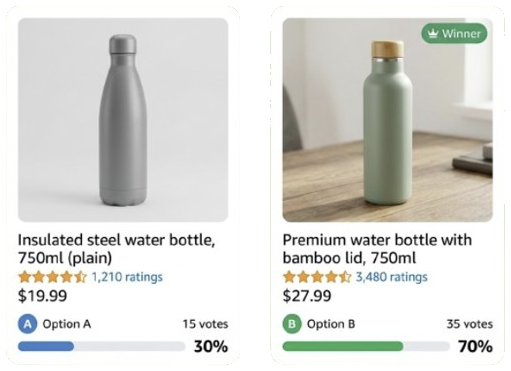
Preference test in the Kosmo platform: two water bottle concepts side by side, Option A with 15 votes at 30 percent and Option B marked winner with 35 votes at 70 percent

Sample study. Reasons given: looks more premium, 48%.

What you send us

A Figma prototype, a Lovable build, a live URL, a deck, packaging artwork, or a few static screens. Nothing has to be finished. The most common reason a concept test does not happen is a team believing they are not ready yet, and an unfinished concept is exactly the thing worth testing.

Who runs concept tests with us

Founders before they build

One idea, two ways of framing it, and a decision to make before engineering time goes in.

Product teams choosing a direction

Two designs the team disagrees about, settled with evidence rather than seniority.

Teams entering a new market

A concept that works at home, tested with people who have never heard of you. See the markets we cover.

Frequently asked questions

Concept testing puts an idea in front of the people who would actually buy it, before it is built. Participants see the concept, choose between versions, and explain the choice, so you learn which version wins, who it wins with, and what would have to change for everyone else.

Around 100 responses is enough to compare two or three versions and read the result by one or two segments. Smaller samples still show direction but cannot be split. If the decision rests on a difference of a few points, the sample has to be larger.

A Figma prototype, a Lovable build, a live URL, a landing page, packaging, an advert, pricing, positioning lines, or a few static screens. Nothing has to be finished.

A survey asks people to rate things, and people rate almost everything positively. A concept test makes them choose one option over another and give up the one they did not pick, which is the only way to see a real preference.

An A/B test needs a built product and live traffic, and it tells you which version performed better without telling you why. Concept testing happens before you build, with an audience screened to match your buyer, and the reasons are the output. Most teams use both: a concept test to choose the direction, an A/B test to tune it once it is live.

Two to three weeks from brief to readout call. Recruitment is the variable: a general consumer audience takes days, a narrow professional audience takes longer. See how we work.

Which version should you build?

Send us the concepts and we will come back with a scope, a sample size and a figure.

Book a free 30-min call Run it yourself